Saturday, 29 April 2017

ANTARCTICA 2017
My once-in-a-lifetime trip to Antarctica, my 7th and final continent to conquer, began with a business class journey with Lufthansa to Buenos Aires. The entire vacation was courtesy of an inheritance from my cousin Celine who died of motor neurone disease.

Flight to Argentina
Being such an epic and special trip, I pushed the boat out and booked Business Class with Lufthansa from Dublin to Buenos Aires, where all the people for this voyage were required to meet up, no matter what part of the world they might come from. First I flew the short hop to Frankfurt, and was able to avail of the executive lounges to relax, sip coffee or wine, nibble on goodies, charge up my electronic devices and avail of the Wi-Fi. The second hop was a long 14 hour one on board a 747, and I was glad that nobody was occupying the seat next to me, affording me of even more privacy and space to put stuff. The flight was totally smooth, but oddly I remained awake throughout, even though I was lying fully flat and comfortably on the electronically controlled seat. Arriving after dawn, the aircraft began its descent over Uruguay, passing the city of Colonia and across the enormously wide Plata estuary before reaching Buenos Aires the other side.

Hotel Emperador
Along with all the people who were taking the Antarctica cruise, I spent one night in the very comfortable old style Emperador Hotel, which is located in a nice area of the city. But I was too tired to explore, having not slept at all during the long flight, and I devoted my limited energy to checking in with the Hurtigruten office which had set up in a conference room in the basement. They advised me of the very early start next morning and to have luggage out by 10pm that night, which I would not be seeing until I reached the cabin of my ship the following evening.

Flight to Ushuaia
A 3 ½ hour flight with Latam airlines brought us to the southernmost town in the world. Descending to Ushuaia over the Beagle Channel, a wall of mountains hugged the plane either side right down to the landing at the airport on a small flat island which is linked to the city by a causeway. Ushuaia has an idyllic setting and is an attractive and colourful city rising up the steep mountainside from the shore. The spectacular landscape reminded me of the wilder parts of Norway and the Isle of Skye in Scotland.

Tierra del Fuego tour
Being a small airport, it wasn’t long before I was on board my bus for a pre-cruise excursion, destined for a tour of Tierra del Fuego National Park. The first commercial premises we passed as we in the suburbs of Ushuaia was a huge pet grooming and supplies shop. It was indicative of the extent of dog ownership in Argentina, as again I encountered in Buenos Aires. It took little time to reach the entrance of the national park, and the beautiful green and blue wilderness which lay beyond. Fortunately the elements were kind today, with some sun and some light sprinkles of rain. Our young redhead local guide told us that today we were experiencing the fairest weather that this region of southern Patagonia can offer, being at such a southerly latitude, akin to Norway in the northern hemisphere.
We encountered people camping in the wilderness, which is permitted here once you clear up after yourself. Boardwalks provide wheelchair access to some beautiful viewing points, but of course the intrepid able-bodied navigate into the remote backwoods. A visitor centre provides eating and picnic facilities and an interpretive centre. Very close by is the border with Chile, the location of which was subject to disputes and negotiations and mutual enmity in times past.
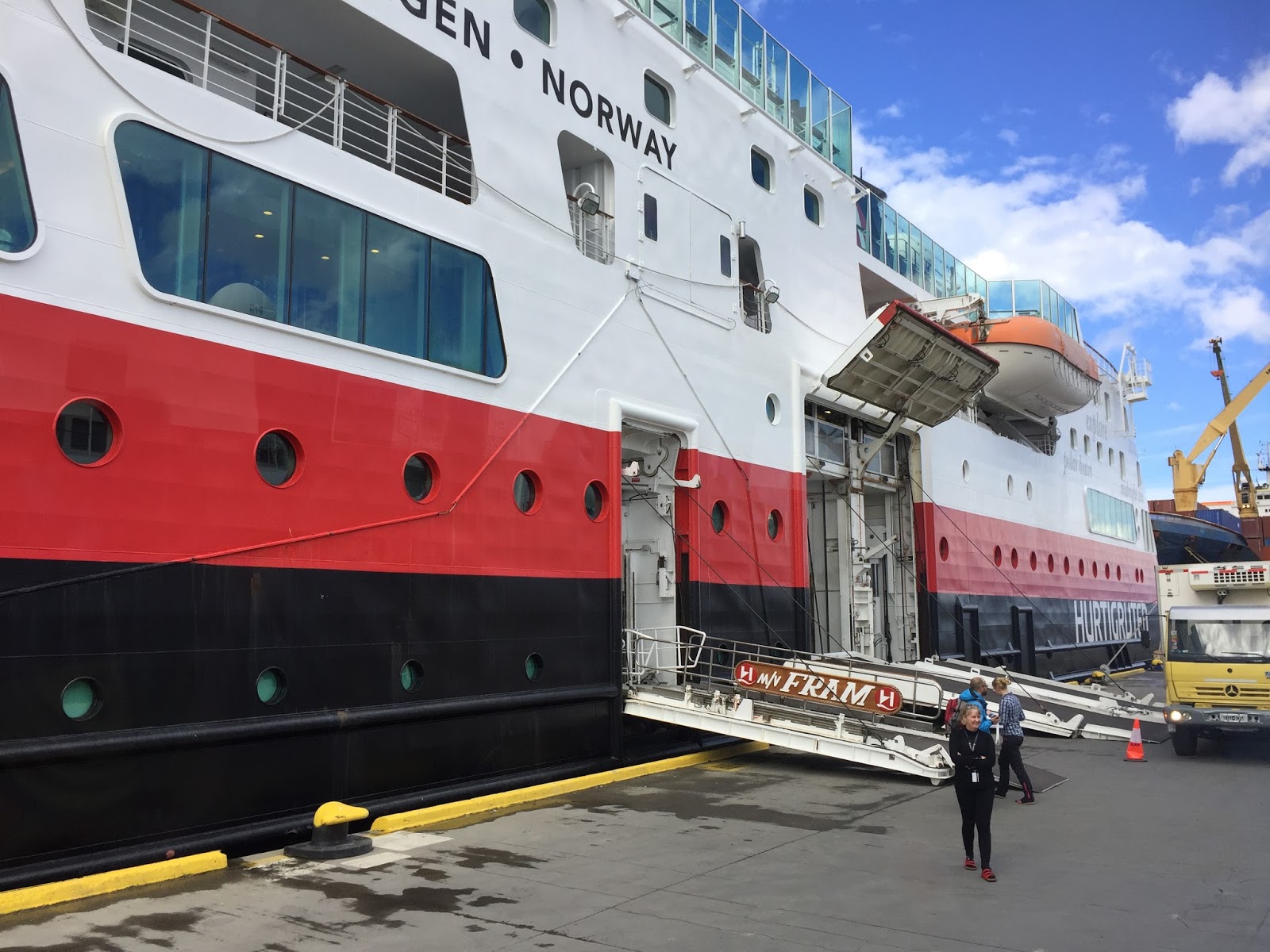
MS Fram
Late in the afternoon we were driven to the quayside where our ship, the MS Fram awaited us. A medium sized vessel, it is part of the fleet of Norwegian shipping company Hurtigruten, with whom I had voyaged previously. I had a compact outside cabin on deck 3, just perfect for me and cleverly designed, but a bit of a squeeze for two people. The vessel has 7 decks utilised by passengers. The Panoramic Lounge is named well and has telescopes for closer viewing of the wildlife from the cosiness of indoors. Just outside of it is a spacious outdoor deck with two Jacuzzis. From here can climb up to the top outdoor viewing deck for a bird’s eye view of what lies in wait ahead. Deck 4 has the attractive dining room, the main reception area, shop, lecture rooms, charts and information boards.
We set sail just as I sat down for dinner. Tonight, as with most nights, it was a very tasty self-service buffet featuring soup, Norwegian cold cuts of venison, pork, salami etc, smoked salmon, lovely breads baked on board, a different feature roast every evening (beef/pork/gammon/venison/chicken/duck/lamb), pasta and casserole dishes, vegetarian options, and invariably those long carrot crisps which I grew so fond of, and Norwegian lingonberry sauce to serve with anything and everything. Little dessert cakes and mousses were on offer to have with the coffee.
Half an hour down the channel, the ship turned around, headed back to Ushuaia. It was announced that a couple had missed boarding Fram due to a flight delay, and that we were turning back in the hopes of picking them up and saving the day. In the event the port authorities refused an unscheduled non-emergency docking, which must have been most frustrating to the couple who were left to watch the ship go, come back and go again.
Safety drill was performed. We were introduced to the Captain and crew. Our Norwegian Captain looked and sounded the part with a deep, loud, slow and deliberate enunciation. We had a female Navigation Officer who was later to give us a lecture in the art of navigation and what she would have to do in the unlikely event of all systems failure.

Drake Passage
The expanse of sea between the tip of South America and the Antarctic Peninsula is known as the roughest area of water in the world. Part of the South Atlantic, the Southern Ocean, Drake Passage is notorious from the times of early exploration. Rounding Cape Horn was a feat of survival in those early ships. In high summer, such as this time in late January, it posed a more moderate threat to the wellbeing of my very delicate sea-going stomach. It was a bit rocky, but not dreadful. I enjoyed a Jacuzzi on deck in between watching giant albatrosses following us in our passage. Having the largest wing-span of flighted birds, it is considered very unlucky to have an albatross land on the ship as it cannot take off again due to insufficient take-off run. It’s stranded like a big 747 that has landed in a large farmer’s field under duress. It took two full days to cross the Drake Passage before reaching our first anchorage in Antarctica.

Yankee harbour
Our first landfall in Antarctica was at Yankee Harbour in the South Shetland Islands, under a very grey sky. Ms Fram anchored, and the tough little metal Polarcirkle boats took us speedily to shore in the very quiet waters on the lee side of a long narrow spit of grey pebbles.
Landing was on the steep long spit of shingle. We were assigned into small enough groups for landing purposes, each group being assigned the name of a creature which inhabits Antarctica. I was one of the “Snowy Sheathbills”, pronounced more rudely by the Norwegian exploration team as “Snowy Shitbills”, always making the English speaking among our group smile. All groups were named after Antarctica wildlife. The Snowy Sheathbill is an unpretty bird which serves as the vulture or undertaker of the continent, cleaning up the remains of death.
Before this and every landing I had to don waterproof trousers which I purchased on board, and boots, wind and waterproof hooded jacket and floatation vest supplied by Hurtigruten. Boots had to be disinfected before disembarkation, and cleaned upon return. Even camera and telescopic equipment had to be vacuum cleaned before all landings. All in the interests of preventing disease and organism transfer from place to place, which otherwise could impact greatly upon the local environment.
The expert Exploration team of scientists had already landed and assessed the area for wildlife, picking the most appropriate landfall spot, and setting cones to guide our walking route. This is what they team did at every anchorage, to ensure least impact on the environment and maximum safety for all. The most import thing was always not to upset the penguins, their eggs, and chicks, and to keep our distance from the aggressive fur seals, which could move with surprising haste with their four short limbs.
At Yankee Harbour I saw lines of Gentoo, Chinstrap and Adelie penguins parading in lines down the grey spit, gathering in several areas where they made huge noise. The fur seals eyed me warily from a distance I was keen to maintain.

Brown Bluff
MS Fram approached first landfall on mainland Antarctica in full sunshine, at brown Bluff, a well described headland which is covered with brown lichen, the only flora which is found on the continent. It was a another fairly steep gravel beach landing, with the sun shining brightly this time, enhancing the stark and bright beauty of the place. Penguins abounded, and I was nervous of stepping on an egg and resting chick as I explored the great big lichen covered rocks. I watched an adult penguin feeding its great big fluffy baby, fractionally bigger than the parent in size. This was the first place I could smell the stench of death in addition to penguin faeces, as bird corpses rotted, their owners having succumbed to the forces of nature such as ice avalanches, storms and everything Antarctica could throw against the continuity of life.

Deception Island
The landing was very easy on Deception Island, a circular isle of volcanic origin with a narrow entrance for ships. The Polarcirkle boat took me to a lovely smooth black volcanic beach where I stepped on land and walked the length of the strand which was backed by dilapidated buildings from the old whaling station. Ironically, in this land of cold, the volcanic sands ere were marginally hot and steaming at the edge e of the water. Some people opted to take a dip in the sea, which was 2C below the warm first inch of water, and I was amongst those who received the certificate of the Polar Plunge. It was a very quick swim; I dunked down and swam 6 strokes, and jumped out again before my body went into cramps.
Deception Island is full of old storage tanks and works from the days of the whaling industry, where they siphoned off the fat and blubber as fuel. A part of the volcanic beach was used as a landing strip for aircraft, and some accommodation buildings are still in existence. It’s a fascinating place, a bit of Lanzarote in the Antarctic.
      
Wilhelmina Bay
Today the sun shone bright and we all had the joy of experiencing an extended sea excursion by Polarcirkle boat to witness close up the activity of the whales of Wilhelmina Bay. It was an extraordinary experience seeing the giant beasts plunge beneath our relatively fragile vessels, only to surface briefly for an expiration of a spout of sweater from their blowhole and a sweep of their tailfin before another plunge. These were Orca, Killer Whales, in pursuit of a Minky whale to drown by force and exhaustion and eat the carcass thereof. I had no stomach to witness the wise of blubber of the dead animal below waters, and retreated to cabin upon return of ship. However, I couldn’t escape the news broadcast through the public address system of the ongoing pursuit of the poor creature which took four hours to finally kill. Often I hate nature so much that I blindfold myself to it.

Lemaire Channel
Our Captain gave us no guarantee that we would get through the infamously ice-chocked and spectacular Lemaire Channel, but he said it was well worth the try if only to experience the immensely beautiful scenery. Tall ice clad mountains arise each side of the narrow passage, such that it takes your breath away. The sun shone bright, the skies and sea were bright blue and crystal clear. I was so excited that I almost danced from side to side of the vessel and up to deck 8 to get the best views. Just as we were near the end of the channel a great big iceberg sat right in the middle, blocking our passage. We turned around, delighting in the scenery once again, and made our way the long way around the island to get further south to Vernadsky.

Vernadsky
Beneath a grey sprinkling of snowdrops Ms Fram moored within shouting distance of the tiny Ukraine scientific base, Vernadsky, which was gifted to Ukraine by the British as soon as it broke free of the USSR. The Ukrainians maintained the base exactly as it had been inherited from the British, zero changes in the name of legacy. Now, the base’s doctor was our tour guide, with a medical and dental responsibility of little more than 20 men, and who spoke just a little English. An enthusiastic and friendly guy, he showed us through the generator room with solid diesel engines of certain vintage, and on through his doctor’s room which was a museum piece where he had to treat his patients with the best patch-up he could offer in such a remote location. There must be a refrigeration point where the deceased can be preserved in a state of rest until transfer to the comforts of home cemetery. A large vodka still has been essential here to tide the men over harsh year round climate, especially in the absence of television and internet. The vodka is briny from been distilled from sea-water, but has a distinctive piquant kick. It is served in the historic English bar. A number of the men engage in crafts to sell the souvenirs, like ultra-remote men’s sheds- and I purchased from them a cross-stitch picture of their logo, a penguin performing a Ukrainian dance.
   
Detaille Island
A traditional Hurtigruten Polar Circle ceremony was held as we crossed the Antarctic Circle, in which I partook. Foolishly I kept my weatherproof Hutigruten jacket hood up. But King Triton took it upon himself to pull back my hood, made a big gap down my perished back and pouted iced water down there and down my front, thoroughly saturating me. As a reward I got a mini glass of warming Aquavit! Landing on Detaille Island was not really an option for me, as I was developing increased lack of balance and footing. This landing was challenging for everybody, but I stayed on the Polarcirkle boat and got a glimpse of the British Base building.

Horseshoe Island
Next stop was another British base at Horseshoe Island, where they sell stamps and can post cards bought on board ship, which will eventually reach their destination after some considerable delay. Once again the landing was not possible for me, but I enjoyed the speedy Polarcirkle boat ride all the same. For some of the past several stops, there were opportunities for passengers to arrange to camp on shore overnight, a novelty which did not appeal to me, especially as it cost so much extra for the pleasure of denying oneself the comforts of life on the ship. There were also possibilities of doing special kayak trips from some of the landing places. I attended some of the very interesting lectures on the subjects of wildlife, navigation, Antarctic exploration history, etc. The trouble was that in the darkened lecture room I almost invariably became seasick and ended up having to leave the lecture about a third of the way through. That was in spite of taking full doses of travel sickness and anti-nausea pills. I found that either eating, dosing horizontally or going up on Deck 7 were the things that saved me from the lurgy.

Stonington
We landed at Stonington Island, where lies an abandoned British station, off the coast of Graham Land at Marguerite Bay. Again I abandoned the idea of clambering up rocks to get on shore and gain a peek inside the building. It was the most southerly point we were able to reach before returninh northward.

Crystal Sound
The air and sky around Crystal Sound was extraordinary. Blue, crystalline, in parts a bright misty white, it took my breath away. I saw a phenomenon which I had seen described in a book on Antarctica, and one which I called a “snow-bow”. It is like a white bow infused with subtle colours in reverse order of a standard rainbow. Here the sea is encrusted in ice, and sleeping down in the cabin I experienced quite some shuddering as the ship was constantly breaking ice, and with a fierce crunching noise all the time. It was quite a challenge to relax with the ship’s icebreaking equipment deployed to cut passage.

Port Lockroy
It was quite overcast when Fram arrived off Port Lockroy, but it was a balmy 3C outside! It was a pity that the sky was so overcast at this iconic British outpost, famously featured in the documentary “Penguin Post Office”. The historic building is manned by three people for three months of the year, in the Antarctic summer. There’s the official British post office, where I posted six postcards, combined with the souvenir shop where I purchased a t-shirt (Port Lockroy design & logo), place mats, and Christmas tree decorations in the form of tartan penguins, seals and whales! A sort of Scotland meets Antarctica will be hanging from my tree in future. The building is fascinating, with old food tins and utensils left exactly as they were on final mission to the island base. Beds, soft porn images painted by the occupants, and old technology are evident on the island base.


Filipino Buffet
On our second last night it was delightful to partake of a Filipino buffet, prepared by and in honour of the crew, who were mostly from Philippines. I was very excited to experience this Asian culinary experience, and what a delight it was. There were special breads, peppery sweetcorn soup, salads, a beautiful suckling roast pig, and a couple of delightful meat dishes including a dark rich spicy beef stew. Lovely desserts featured too. It was a feast to remember.Drake Passage
As MS Fram set out over Drake Passage it was announced that we would be going full speed ahead as a passenger was in need of urgent medical attention. It was to take just over one and a half day’s voyage rather than the full two days. Of course full speed meant we were encountering the high seas of notorious Drake Passage with maximum impact, so I had to ensure I had my maximum allowed dose of travel sickness tablets at hand. There was nothing scenic to distract the eye, but the relentless waves which smacked hard against my cabin. My strategies to beat the lurgy was to either feed up my stomach when I was ok, take to the open air deck in the Jacuzzi or on a deck chair. Or else take to the bed in my cabin and41 doze.

Arrival back to Ushuaia
The ship arrived in Ushuaia after lunch, and all of us, including myself, who were curious, watched as the seriously ill passenger was taken on shore by a waiting ambulance to the local hospital. He looked totally immobile, and it turned out that the Chinese gentleman was an elder (not very elderly at all!) of a larger family.
  
Escondido tour
Along the road out of Ushuaia was quite shocking to see huge billboards with pictures of children and young people with rewards offered for returning them safe and alive. I don’t pretend to know much about this hostage/reward situation in Argentina, or the police services or billboard advertising industry or legal situation in the country, but these ads gave me an uncomfortable feeling. It alarmed me to the number of people who ‘disappear’ in the country. The road was blocked by the corpse of a horse who had come to meet his maker on the highway. Horses seem to wander wild and free just about everywhere in the region. Ambulances raced to rescue what I don’t doubt were human victims of the speedy highway. A beautifully brooding landscape and sky added a note a dramatic despair to whole experience.
Our young guide added a more cheery note as he shared his knowledge of the nature and climate of the area. Winters are long and snowy, and skiing is very popular. So is dog-sledding, and we pulled up by a sled dog centre, greeted by the howls of the hounds as we were guided to an area of historic and natural interest. The dogs are all friendly; we were reassured, just eager for a bit of attention. He brought us to an area of special interest, an extensive tract of pure sphagnum moss, which is used as a wound absorbent material as well as having agricultural uses. We were shown a big mound in the earth and asked to guess what it was.  A prehistoric mound? No, it was a bunker for storing weapons during the era of dictators in this part of the world, a store of arms to fight the likes of the Falklands War. Our guide said, nobody wanted any of that nonsense, they never did. The power hungry dictators were the big mischief makers of this region in those bad old days, and some of them continue to further be in more northern countries on the continent.
Some miles onwards we stopped at our ultimate viewing point for a peek at Lake Escondido, a giant stretch of water in the distance beyond a smaller lake in the foreground. A very beautiful area in a melancholic sense, it would take days and even weeks to explore its full riches.

Flight back to Buenos Aires
The seriously ill Chinese man, having refused further hospital treated, was carried to the boarding gate by his family, but refused boarding. Presumably he was forced to return to appropriate hospital care.
The flight from Ushuaia began with a turbulent ascent over the tail end of the Andes, a smooth middle and a turbulent conclusion through a thunderstorm ridden descent down to Jorge Newberry airport in Buenos Aires. Landing at the domestic aerodrome gives the impression of touching down in a city park, with tall trees to either side, all overlooked by an elevation of posh residential edifices. An interminable taxi ride through heavy rain and even heavier traffic took me the modest distance to Hotel Puerto Madero, located in the gentrified old docklands area, which closely resemble that of Dublin. I had got the taxi at a fixed fare rate and the driver was pretty excited to receive my tip.

Hotel Madero
The Hotel Madero is located in a gentrified area of the docklands, which is very like a similar development in Dublin city. I loved this chic modern hotel from top to toe. My bedroom was ultra- smart, and I was delighted to avail of a sm41all swimming pool on the top floor with an open terrace where I could gaze down on the city. Members of staff were helpful throughout and dining was good experience. A selection of house breads provided a taste sensation not to be forgotten. Upon returning home I gave a well-deserved report on TripAdvisor. The hotel’s location made for very enjoyable evening walks along the salubrious pedestrianised docksides, lined with pavement cafes, colourful artwork, and renovated cranes. A place where families promenade with pram and dog in tow, safe in the knowledge that it is very well policed and safe in spite of its proximity of a shanty town area across the water.

Tour of Buenos Aires
I had booked to be on a small group 3 hour tour of Buenos Aires, to get an overview of the city. My intention was to save a better acquaintance with the city on a more in-depth tour which is on offer twice a year with Travel department. I was the only native English speaking person on the tour; the others were Spanish, French or Portuguese speaking and all very amiable folk altogether, much more so than the passengers on Ms Fram. The guide was just delightful and introduced us to the very heart of the city and the Casa Rosada government building where Eva Peron addressed the people from the balcony.

Homeward Bound
I departed Buenos Aires on a frantically wet morning, with the rain thundering down on the glass ceiling of the airport, making a noise that co41uld have come from hell itself. However the 13 hour Lufthansa 747 flight to Frankfort was smooth as silk and I slept throughout in my Business Class seat, only to be woken for breakfast by the flight attendant who said “Wakey, wakey, sleeping beauty, I’ve never seen someone who’s slept so soundly throughout a flight!”
In Frankfurt Airport I caught the short flight home. I had chosen a window seat for the short sectors, but on this occasion I was sorry that I did. I was beginning to feel out of sorts and bot hungry at all, and declined everything except water. The lady beside me had her wine, Campari, and meal laid out on her own and the centre table at the absent seat which serves as an extended buffer to personal space on short haul Business Class. I had developed massively painful belly cramps and nausea, and couldn’t get comfortable no matter what I did. I suddenly had to ask the lady to make way for me to rush to the washroom. Her drinks and food nearly went flying! It became clear that I had suffered an acute blockage in my gut below the stoma, caused by the indigestible and un-chewable sweetcorn I had consumed 4 days earlier at the Filipino feast. I was able to remedy this immediately, and the pain and nausea disappeared, but I was left exhausted for the next hour. It taught me a lesson on what never to eat again!
I arrived home safe, full of memories, happy but a bit jet-lagged after my adventure of a lifetime and with a mental energy for another epic trip!


-0-0-0-0-0-0-

Monday, 16 May 2016

Myanmar April 2016


Myanmar April 2016


On 3rd April 2016, I was amongst a group of Travel Department tourists who departed Dublin Airport on an Etihad ticket bound via Abu Dhabi and Bangkok to Yangon, largest city and old capital of Myanmar, the country formerly known as Burma. 

It’s a country I had for some time hoped to visit, inspired by its lack of a presence on the tourism beat. In preceding years travel was deeply discouraged by pro-democracy leader Aung San Suu Kyi, but things were changing. She came into a position of quasi-power virtually the day we arrived, following elections and agreements, and the birth of a new democracy had taken place with all the potential which this brought. The military was still to be a part of the government, at least for the time being.

As the airplane approached the runway at Yangon we flew close to an impressive golden pagoda, the first of many I would see during the trip. At the airport we were met by Moh Moh, our guide who turned out to be a very caring individual, a mother hen who went beyond the call of duty when it came to looking after our needs. Our bus had a picture of comical Mr. Bean in the driver’s window, giving the impression that Bean himself was driving the vehicle.

It soon became apparent that traffic congestion is an enormous problem in Yangon, and that it takes considerable time and patience to drive even a short distance. There are no yellow boxes, so jams occur everywhere, and traffic lights are ridiculously biased in many places such that vehicles are at a virtual standstill. It amazed me that all the cars I saw were unblemished by evidence of any collision dents.


After a journey short in distance but long in time, our group of 19 arrived in the impressive modern Sedona Yangon Hotel.  A morning snooze was followed by an afternoon trip to see the glittering gold complex of the Shwedagon Pagoda, which simply breath-taking. At its heart is the immense golden stupa which is surrounded by an array of diverse gilded shrines where statues of Buddha are venerated by the legions of the faithful. Devotees busy themselves by presenting flowers, lighting candles and incense sticks, inserting money in the large glass boxes in almsgiving, and pouring water over Buddha in veneration. Some chant in prayer whilst every now and then a line of young folk sweep the floor with a brush six people wide. Everybody is barefoot, and we were soon to realise that half our holiday would be spent shoeless in the multitude of pagodas and temples we were to visit. Shwedagon is the holiest place in Myanmar, and is to the nation of Buddhists as Mecca is to Muslims. At a nearby shrine we saw one of the country’s giant reclining buddhas.


At some shrines a selection of the Buddha statues are crowned by haloes of glittering multi-coloured lights, which brought to mind slot machine arcades that one might find at Las Vegas, or back at home in the amusement arcades of Bray. To my European mind these looked quite undignified, quite unholy, but these gaudy flashing haloes symbolise Buddha’s enlightenment and are very meaningful to the faithful.

The Sedona, as most of the hotels on this trip, provided a large well-appointed room with a large bed for a great night’s sleep. Breakfast was impressive too, featuring a great selection of dishes from fluffy omelettes, to croissants and pastries. I discovered that marmalade is quite a tradition in Myanmar, dating from the days of British rule. Great tasting baked beans featured in several hotels, produced in Myanmar. This morning the hotel offered an assortment of breakfast items from Korea, and I tucked into these straight after the omelette, bacon and beans. A nice belly full to start the day of touring the most populous city in the country.

The morning was started by a by-pass of golden Sule Pagoda which is rather ignominiously encircled by a “basement” of shops. We stopped by City Hall and the High Court, from where I took a walk in the main city park.  I was amazed by the performance of the conductors of the city buses, who would literally hang out from the door and frenetically scream out the names of the various stops ahead on the route. They would then pull the passengers on board in an effort to speed up the process.
 
Guided by Moh Moh, we walked the streets of old Yangon, passing by various street food sellers, including a couple of stands where roasted crickets were on offer. The old British colonial centre has some grand old buildings, in various states of disrepair. Not easy on the olfactory senses, the whole city has a characteristic stench of sewage, fragranced by the fermented fish condiment which figures in the local diet. We stopped by to visit the Scott Market, which specialised in stalls selling mainly fabrics, items of dress and jewellery. What caught my particular attention were the colossal fire extinguishers placed at intervals along the main beat.

Our bus journeyed further through the city, and around one of the city’s two major lakes. The Bogyoke Aung San Museum is the house where Aung San Suu Kyi grew up, and we saw her wooden bed where she slept next to her siblings as a child. Her father, Major General Aung San, was responsible for ridding Burma of British rule, but he was assassinated for his efforts. His book collection remains on view in the house, and features plenty of English literary volumes, including works by Shaw. We stopped by the lake shore where a magnificent vista was enjoyed by all, from the rickety wooden lakeshore walk. The sun was setting over silhouettes of pagodas and palms in the distance, and a superbly impressive golden dragon-boat shaped restaurant took pride of place in the foreground, enveloped by beautiful purple jacaranda trees.


After the two nights in Yangon we were obliged to be up and ready for departure by 5am for our domestic flight to Bagan. It was a simple matter of leaving our luggage outside the bedroom to door, from where it was transported for us, to appear again in the bedroom of the next hotel. This was done most efficiently throughout our trip. There was no check-in at the airport, simply a KBZ sticker to apply to our clothing to identify us as passengers as we were waived through and on to the modern ATR turboprop. KBZ is a bank in Myanmar which owns one of the domestic airlines. The safety cards are huge, almost the width of the seat. During the very short flight we were served a breakfast of pastries, a chocolate, orange juice and tea. Obviously they haven’t attended Michael O’Leary’s school of airline operation.

Bagan isn’t a city or even a town, rather an area of over 10,000 ancient temples and stupas which remain in pretty perfect condition. There is a small modern town located in the region, but the airport mainly serves those interested in visiting this extraordinary place which is peppered with an extraordinary medley of places of worship, most within metres of one another. It’s a spectacle the likes of which I’ve never seen before, so many are the monuments. Some are great and elaborate, some miniscule and humble. Some are white, others terracotta, some gilded. The sheer landscape of pagodas and trees is exceptional. Balloon flights are offered, but unfortunately there was no time to avail due to the ever busy schedule.
 
Our first port of call was the impressive stone temple of Ananda Pahto with its vertiginous steps which I avoided. We also visited the beautiful temples of Gubyauknge and Htilominlo Pahto. The sheer amount of styles and rural landscape surrounding these buildings added to their eminence.
Our hotel for the next few nights was Aye Yare River View Resort, a most lovely establishment spread out over a number of buildings, with a lovely freeform pool. On reflection I think this was probably my favourite accommodation during the tour. It had the cosiness of a small spread of grounds combined with the impression of the seclusion of the various buildings and curving pathways ornamented by plants and trees. Food was excellent which featured delightful fillets of river fish wrapped in banana leaves.
 
One of my favourite aspects of the holiday was the visit to a farming village community, where the houses are made of bamboo. Each one has a yard where gentle white oxen shelter under bamboo awnings, and chickens roam freely. The oxen are employed in various tasks, one of them being to turn a peanut oil millstone. Everything in these communities is made by hand and labour, with everybody busied with the tasks of living a simple dignified life. We enjoyed the hospitality of one of these houses with a nice cup of tea and roast peanuts grown on the farm.


It’s not exactly the most arable land, but supports the groundnuts, cotton, and some delicious small bananas, fruits and vegetables are grown in the area and sold in the local market. Tobacco is grown and crafted into charoots which are popular with the ladies. We watched the villagers at work on the various crafts, including that of producing the fast fermented and distilled toddy. In order to produce this men climb up the coconut palms, retrieve the fruits, collect the liquid and ferment it overnight for a quick distillation process. It is pure fire-water!

The local bamboo library had no computers, but children were avidly reading their books as I peeped in. It’s quite a different scenario from the libraries I work in, and I don’t think my young customers would put up with books alone to entertain them.

Then there was a visit to a lacquer workshop, where ribbons of paper are formed into the shapes of bowls, small and large, and the most fanciful of urns. They are skilfully dipped and painted in layer after layer of lacquer, with the final product a true work of art.
 
We partook of an evening sunset cruise on board a very dodgy vessel which was accessed across a narrow plank, with a helping hand from the boatmen. Health and safety is not yet a feature of this developing country, especially in the matter of boating, but I guess this might change for the better within the coming years. It was nice sailing down the Irrawaddy, with a low cliff bank to one said dotted with stupas here and there. We stopped off to visit a cave pagoda, and then turned around the face the setting sun.

The following morning we left Bagan by coach in the direction of Mandalay, the second largest city in Myanmar. On the way we stopped at a major place of Buddhist pilgrimage, the great Mount Popa which is a flat topped volcanic plug upon which a monastery buildings were constructed. A large number of steps winds around the steep sides, with shrines placed along the way, rather like a “stations of the cross”. Below the mountain there is a medley of some quite fancy buildings, some of them serving as overnight accommodation for pilgrims. We saw a busload of young nuns arrive. These children can decide whether they wish to continue dedicated religious life when they reach adulthood, or like the majority, lead a secular life. Same goes for the monks, who begin their novitiate as children. Like most religions, the males are considered more important than the females.


It came time for lunch. Climbing the hills through a sandalwood forest we dined at the beautifully tranquil, luxurious and elevated Mount Popa Resort, the most deluxe of our lunch stops. Located on an elevation, we had a view across to the fine conical mountain of Mount Popa, upon which top lies the monastery. It is a magnificent sight. At the entrance to the resort are some fanciful carved teak tables featuring the shapes of snakes and dragons. We dined at more practical tables on the veranda.
Roads are improving in places, and we continued our journey on a dual-carriageway. Driving conditions are generally somewhat better than, say, in India. Arriving in Mandalay we were accommodated in the Sedona Hotel, equally as impressive as its counterpart in Yangon, having sizeable rooms, and a capacious pool which I took advantage of no sooner than I had arrived. As darkness had fallen and the pool was illuminated I enjoyed a swim without the scorching sun. Attentive staff handed me towels to dry off afterwards.

Next day the temperature was at its highest during the entire trip, a high dry 45c. I was surprised by the way I coped with the heat, but this was helped by plentiful opportunity for shade in the workshops and temples. During our city tour we stopped on a street where hundreds of white Buddhas occupy the sidewalks in their various stages of completion. Women and men were busy at work chipping the blocks of stone into Buddhas for which there is an infinite market.

A remarkable pagoda we visited is Mahamuni Paya, where sits the most revered and extraordinary Buddha image in Myanmar. Only the menfolk are allowed to go near it, the ladies amongst us had to contend with viewing it by cctv. The tradition is that the men buy an affordable patch of gold leaf and apply it to the great statue as a mark of reverence. This figure has so many patches of gold applied to it that it is ridiculously knobbly in appearance, which in my view renders it comical and extracts from its dignity.


Late afternoon we proceeded in the direction of Mandalay Hill, which could be seen from the hotel. Just below the peak is Kudothaw Pagoda, wherein lies the World’s Largest Book with over 1.400 pages , each set in a marble tablet, every one measuring over five feet tall and enclosed in a little white stupa-like edifice. It all reminded me of rows of bright white mausoleums in a cemetery. At the heart of the “cemetery” is the great golden stupa of the Pagoda.

Stepping out of our tour bus, we boarded small rough vehicles which took us up the steep and narrow winding road with plenty of hairpin bends. At the top was were two towers, one with a lift, the other with a set of moving stairs to bring us up to the crown which is occupied by none other than (you’ve guessed it) a monastery . A floor of shiny hot tiles scorched our feet and reflected the dipping sun. There were great views looking out over the nearby Kudothaw Pagoda and the city beyond. We watched as the sun blazed red and dipped below the horizon.

The morning brought more searing heat, but it was nice and cooling to be on board a nice solid boat which brought us down the Irrawaddy to the ancient town of Mingun. Ox carts brought us to the various antiquities beginning with the unfinished temple which stands as a huge square lump of rock. An astrologer predicted that King Bodawpaya would die upon the completion of the structure, so advised him that it should not be finished. The king also had an enormous bell constructed to go with the temple, and it stands today as the largest ringing bell in the world. Close by stands the delicate and ornamental snow white Myatheindan Pagoda

 
Later, a tiny passenger ferry brought us across a small tributary of the Irrawaddy to the remains of the old imperial city of Ava, which is now mostly a rural village with some nice remains. In pairs we stepped on board canopied carts drawn by a single small horse. We trekked past the village and out through some of the most delightful and bountiful countryside. Sunflowers, cabbages, sweetcorn, aubergines, coconut palms, oranges, banana trees, tamarind trees, and the most vividly green little rice paddies appeared to either side as the horses clip-clopped through the most intimate little earthen tracks. It was like a magical mystery tour through somebody’s private garden.  Here and there we stopped off by a stupa, the remains of an old bathing pool of the royal estate, and the funny little “leaning tower of Ava”. Our good-humoured cart-driver chuckled with mirth at the comparison with the more famous one in Pisa. Our last stop in Ava was at a great elaborate stone monastery guarded by a pair of stone lions at the gate.

Back on board the tour bus we made the final stop of the day at U Bein Bridge, which is the longest teak bridge in the world. Purely a footbridge it is fairly narrow and has no rails, but the off great wooden post punctuates the vacuum and provides some sense of reassurance of there being “something to hold onto” if needs be.  The bridge is always quite crowded, especially with tourists who often stop in pairs and groups such that one has to negotiate one’s way precariously around them. The riverside provides an interesting scene with boats and shacks on one side and a farm of geese on the other, with hives of activity peppering the serene waters.
 
Next morning we departed Mandalay on board a very brief flight. Touching down at Heho Airport, we had arrived in Shan state. At some elevation, the area felt that bit cooler, and was a blessed relief from the intense heat of Mandalay. The red soil is so much more fertile here in the undulating landscape.


Our first stop was at the Shwe Oo Min natural cave pagoda at Pindaya. The cave is in a great hill, with a very high key entrance complete with giant spider effigy. It looks more like the entrance to a theme park than a religious shrine! But we’d been there before several times with the “arcade buddhas”.  Over 4000 gold Buddha statues occupied the fascinating labyrinth of passages in this sizeable cave system, with various hues of lighting in in each cavern.

The area has several ethnically distinct tribes which live in harmony among one another. It was fascinating watching the various homesteads as we passed by on the coach, with virtually every home having its collection of livestock, and features of their own ethnicity. On our way to our mountain retreat for the night we passed by the old British railway post of Kalaw with its very English style railway station.
 
The Hill Top Villa Hotel was our stop for one night, where we were accommodated in simple but pleasant bungalows with beautiful views over the floral gardens to the verdant hills. I enjoyed sipping some locally bought and produced rose wine on my veranda, watching the evening fall on the verdant hills whilst the lights in the hotel gardens lit up and sparkled.

After a simple al fresco breakfast of omelette, juice, breads and marmalade we travelled down towards tranquil Inle Lake. We visited a Shan paper and umbrella making craft centre. Also we called into a pair of monasteries side by side, one stone and one wooden, the latter featuring a couple of delightfully friendly cat families who resided within. Mother cats and their beloved kitten occupied pride of place, being cared for by the monks.

Drawing up to a canal by Inle Lake I was slightly nervous when I saw the narrow motorised canoe-like boats we were obliged to step aboard. Watching others stepping onto their wobbly vessel, I observed how swiftly it departed down the narrow canal. However I soon became confident when I was comfortably seated, as the boat sprinted and harmlessly bounced off another as it paced towards the open lake. Floating gardens appeared either side of us, with water-lilies aplenty, and bird life manifest. I felt elated as the boat entered the broad waters of Inle Lake. At times the spray became extreme on one side, but the solution was right beside me as I picked up and opened the umbrella which was located at each seat. Looking back with an eye to common sense I think it would have been wise for each of us to don the life vests which were provided on every seat.
 
Now and then we would speed past clusters of purple water-lilies. In the distance I could see the local fisherman performing their ballet. As my boat drew closer I could clearly see one fisherman standing at the stern of his narrow little boat and tip over with his bell-shaped fishnet as he rowed the vessel with one leg. That’s why I describe it as a ballet; it is quite an extraordinary performance, a local tradition confined to this lake. Many such ballet-fishermen were performing on the leg.
We stopped off for lunch at one of the many restaurants which stand on stilts over the water. Crisp fried flatbread, crispy little baby vegetable tempura, pumpkin soup, an array of meat and fish curries, stir fried daintily cut veg, and rice covered with gold leaf. A typical Myanmar luncheon feast, but the edible gold leaf was a first.


Back on board the boats we were brought to some fascinating craft workshops. The most expensive fabric of all, we watched lotus thread weavers producing from start to finish the strong and enduring product. It is an incredibly painstaking process, especially the retrieval of the incredibly fine threads from the stems of the aquatic plant which thrives in the lake.

Returning to the waterside we saw a small pig being transported upside down with legs tied to a pole, from a boat to a nice sun-sheltered canopy where he would be reared for fattening, I managed to get tickling the snouts of some friendly swarthy piglets who were guzzling noisily from troughs under ample shelter.

As we entered the narrow channel through the vast reed beds towards our final hotel, Pristine Lotus Spa Resort, our boat’s propeller got tangled in some reeds and we came to a halt. With a little assistance from another vessel this situation was remedied and our engine once more fired into life, bringing us to the enclosed mooring harbour of our resort-style hotel. The bedrooms here are most interesting. Each one is built in the shape of a wooden “boat” with the bow end forming a balcony with a seated deck overlooking a canal toward the lake, with an ample bedroom with feature sunken bath, a settee, a large bed with mosquito nets, and an open bathroom area with curtained toilet. Reception building is separate to the bar/restaurant buildings and pool area. Another part of the campus is across the reasonably busy marrow road.
 
Today was the beginning of the Buddhist New Year and the tradition is to throw water over other (“willing”) “participants”. In effect The staff and residents of the Pristine Lotus took part in throwing buckets of water over any passing motorist passing on the road between the two sections of the resort. I enjoyed a swim in the pool, followed by a cocktail and delicious dinner in the restaurant.

Last day, we took a short trip by bus to the nearest village where many people bathed in a lake inlet; a walking tour via a linear sheltered market brought us to a place of a myriad ancient mini temples and cemetery. Another motorised canoe trip took us to lunch. The final afternoon was at leisure with a visit to the natural hot rock spa. In the evening, all I, and practically everybody else, could face was a place of delicious crispy chips with ketchup and mayonnaise. Myanmar can do simple fries as well as the best in the world.

The journey homewards started with a morning domestic flight to Yangon. The airport at Yangon, a work in progress, has just a few stalls which sell souvenirs to take home, a whiskey shop and one café. Surprisingly this café served me the best coffee I have ever enjoyed in my life, and the food on offer looked absolutely delicious. Coffee is grown in Myanmar and packaged as a souvenir which boasted "Italian coffee from Myanmar” in an effort to reassure the consumer that it was a quality product. Some hours later we boarded the Bangkok Airways flight to Bangkok to join the Etihad flight to Dubai. Another Etihad flight brought us back home to Dublin, where I wished my bright pink case off the carousel and out into the perishing cold outdoors of Ireland.

-0-0-0-


Tuesday, 28 July 2015

Scotland June 2015


I just love going to Scotland on holiday, yet there is more often than not one has to make a sacrifice in the weather. Why have I this enduring fondness for returning to the Highlands and Islands? One aspect was answered for me in an episode of the geographical TV series “Coast”, which described Scotland as the second most intricate coastline in the world after Norway, another favourite place of mine. There is a lot about Scotland that reminds me of home: the Gaelic language, areas of desolation, the ever changing weather, the hospitality, and a lot of quirkiness. But what’s familiar always has a twist, like the backwards fadas of the Scots Gaelic as opposed to the forward accents of Irish. The areas of wilderness are far greater in Scotland, there is a wealth of islands great and small to explore. There is a lot more travelling to be done there!

On this escapade my main focus was to see the Isle of Colonsay, an island about ten miles long, which I’d seen in a television documentary a good few years back. I knew it had a fairly large estate house and garden, a famous golden beach, and a smaller island of Oronsay to the south which is accessible at low tide and which features a monastery that predates Iona.

I took the Aer Lingus/Stobart flight from Dublin to Glasgow, and caught a Citylink Bus from Buchanan Bus Station to Oban, where my bed for the night was the Royal hotel. A fairly basic hotel, and I mightn’t want to stay here for more than a night. At least it has single rooms, staff are friendly, and breakfast is decent, and it is very central. Typical of a Scottish lower to mid- range hotel the décor featured tartan, which at least affirmed I was in Scotland.

The journey from Glasgow to Oban is a lovely one, going via some lovely Argyll countryside by way of Loch Lomond, Rest and Be Thankful, Inveraray, and Dalmally. Oban itself is a very likeable town, set in a bay with hills rising behind and dominated by the Colosseum-like structure of McCaig’s Tower, a folly built by a wealthy banker as a tribute to himself and his blood relatives. He died before completion, so it is only a shell of what it might be.

Oban claims to be the seafood capital of Scotland, and pertinent to this is the al fresco seafood bar which serves the freshest of produce at a reasonable cost, to be enjoyed at a long outdoor bench and table to be shared by fellow fish-lovers. Indeed there was another such alfresco outlet with outdoor tables and umbrellas. Several indoor restaurants specialise in seafood and there are two gourmet fish and chips shops where one can eat at tables or take away.

I had more than half a day to spare before my ferry to Colonsay, so I started out by taking a one hour boat trip to see the local seal colony. The seals had pups and they all seemed to blend in with the local rocks. We passed by a large fish farm which supplies salmon to a lot of supermarket stores in Britain. I remember doing this little boat trip during the 1980s when I spent a sunny week in Oban. It is a superb holiday base, with so many ferry trips available to other islands as well as bus routes and roads to so many interesting places.

I walked down the Corran Esplanade, the hotel-lined promenade which leads onto the road out to the nearest beach at Ganavan Sands, under two miles away. I dropped into the Oban Chocolate Shop and Café, a gorgeous place which was unfortunately packed full with customers. The chocolates are amongst the most delicious I’ve ever tasted.

In the evening I checked in for the Caledonian MacBrayne ferry to Colonsay. A requirement of the crossings is that you give your name, your next of kin and their phone number on a slip before you embark, and hand over the duplicate as you disembark. I guess it is to do with a problem with suicide or drunks falling overboard. On all ferry crossings the initial welcome aboard message by the Captain is in the Scottish Gaelic language. On board these modern Calmac ferries are excellent facilities, such as a good coffee shop, a restaurant serving decent food, and a comfortable observation room. On this very smooth 2 ½ crossing to Colonsay  the ferry was uncrowded and made for a most pleasant crossing. The scenery en route was delightful, with lovely views of the islands of Kerrera, Mull, Jura and Islay.

Arriving at Colonsay pier, I had just started the uphill walk towards the only hotel on the island when a local driver gave me a lift. At The Colonsay Hotel I was shown to my little square single room, named Port Lobh after one of the bays on the island. The un-shared bathroom was down the corridor. At 8.30pm I was just in time to enjoy a nice meal in the dining room, fish with a garden salad from Colonsay House Garden. The hotel has a typical small Scottish country house feel, with nice little spaces in which to get comfortable, such as the Log Room or the Library.

In the morning I took my first walk on Colonsay. Today my goal was to see the famous golden beach at Kiloran Bay, via the grounds of Colonsay House.  So I traipsed the hilly single track road which swung inland from the coastal “capital” village of Scalasaig. This settlement has a grocery / post office, a café, a tiny brewery and a book publisher / bookshop.

Through Scalasaig and beyond, the corncrake sounded his scratchy voice loud and clear. On the islands he is thankfully thriving and I am always glad to hear that distinct sound on my insular travels.

Along the way I encountered many sheep as they scarpered up the roadside rocks to avoid me. Using a fairly basic map I had printed out for myself I followed a track through the wooded outer gardens of Colonsay House. Unfortunately it wasn’t a Wednesday when the inner garden and tea room are open – I had not been careful enough to time my visit. Yet I got glimpses of this garden where part of my previous night’s dinner had been grown. The day was grey but mild and calm, making for nice walking conditions. Some of the pathways proved very muddy and full of animal droppings, not doing my shoes any good. The woodland was ablaze with colourful rhododendrons and dripping fuchsia, with carpets of green fernery and spikes of flourishing foxgloves.

I wandered past hidden cottages which serve as self-catering accommodation managed by the Colonsay Estate. The Colonsay Hotel serves as the administrative centre for the self-catering houses which can be found in several areas of the isle. The modestly proportioned Colonsay House came into view as I came across a crucial junction where I was to take the wrong turn. Instead of heading for the glorious golden beach I convinced myself the circular road to the west was the correct route to take.

Walking for what felt like miles, I passed a school, a quirky house with somewhat scary sculptured heads in the windows, a field with standing stones, a church, a graveyard., a little weather station, more self-catering cottages and a bicycle rental shop. I could see the ocean ahead, with a rocky bay pounded by waves. Where was my golden beach? Opening a gate, I made my way across private grassy land full of black Hebridean sheep and a mobile home, and ended up at the edge of a cliff. No sign of a beach anywhere, just a rocky, boulder strewn shore.

I retraced my steps back to my hotel, and it was only until my second and last evening on the island when I conceded to buy a proper ordnance survey map from the island bookshop that I realised I should have taken the first road out from Colonsay House and Gardens. It would have been so much shorter a journey into the bargain!

On my second day on the island I had plans to visit the neighbouring island of Oronsay, which has very fine monastic remains from Columba’s era, predating Iona. To reach Oronsay one has to time the tides with precision, as the island is reached across a very wide stretch of sand at low tide. I walked the couple of miles south to The Strand, where many cars had been parked by folk doing the inter-island walk. It was a brilliant sunny day and I set out across the fairly wet sands, following the tracks of cars, and people. A post office van passed me on its way back to Colonsay. After a while I stepped onto land in the wheel tracks of other vehicles, and other people followed me suit. I came to an abrupt stop by a house which was backing onto a steep hillside which forced me to re-trace my steps. A couple who followed in my footsteps suggested that maybe we take another ill-defined route through the grass.

Failing to find any trace of a monastery we found a charming wild spot overlooking the open sea. Having spent a while exploring various direction and coming to dead ends  I decided it was time to cross back over the sands before the tide beat me to it. The couple continued their explorations  to try and find the vanished ruins. On my way back to Scalasaig I took a diversionary path to a very pleasant remote area of the isle. The sun shone brightly and warmly for most of my day’s walking.
It was only back in Scalasaig after I conceded to purchase a proper Ordnance Survey map in the bookshop that I discovered for certain that a):- Yesterday I had taken the wrong road in error of the one to Kiloran Bay, and b):- Today I had never set foot on Oronsay, having followed the wrong route over the sand. I should have veered towards the right side of the sands. Instead I had stepped onto an isolated corner of Colonsay. My overall mistake was being too mean to make an online purchase of the map to study the routes in advance.

Next morning I took the Calmac ferry back to Oban where I stayed for the final three nights at the upmarket boutique-style Manor Hotel.  A small Georgian building with beautiful views of Oban from the rear garden, it has several very beautiful lounges with antique furniture and a fine dining room. Dinner was a lovely affair and I enjoyed the seafood grill with several kinds of fish cooked to perfection and beautifully presented with fondant potatoes and fennel. For desert I chose “Chocolate and Orange”, a delightful and delicate medley of miniature helpings of orange ice cream, chocolate brownie, caramelised orange wedge and chocolate fondant. Coffee and petits fours were served in the lounge. My room was modestly proportioned, with cosy décor and a supremely comfortable bed.

The plan for my first day back in Oban was a boat trip with Turas Mara to see the isles of Staffa and Lunga. Initially I took the first ferry of the day to Craignure on the Isle of Mull. After a 45 minute crossing I boarded the West Coast Motors bus to the very picturesque and colourful capital town of Tobermory which is set around a beautiful wooded hilly bay. At the marina, I stepped onto the sturdy little Turas Mara boat which set out past a beautiful four-sailed cruise ship over to the remote Ardnamurchan peninsula to pick up extra passengers. After that the boat sailed south to the small Isle of Staffa, world famous as the location of Fingal’s Cave, where Mendelssohn got the inspiration to compose his Hebrides Overture, from the sound the sea makes at the entrance to the huge cavern. We stopped for an hour on the island. The volcanic formations here are identical to those on the Giant’s Causeway in Northern Ireland.

Leaving Staffa, the boat sailed for about 15 minutes to the wee Isle of Lunga, renowned for its puffin colony. At low tide it was quite a feat disembarking. A floating pontoon allowed us access to a wide beach of slippery boulders which we had to scramble over, sometimes on all fours, to gain access to the grassy area. Then it was up a steep hilly path to the puffins, which are incredibly tame. We were told that they like the human presence because we put off the approach of their predators. A two hour stop allowed us to lie down on the grass very close to the birds and capture countless photographic images. One of the puffins came up from the sea with a beak full of fish, such as I’d seen in wildlife photography, but the second I clicked my camera he was gone out of sight. Fortunately I captured many other delightful images of the birds.

Sailing back towards Tobermory our boat was followed by a delightful pod of playful dolphins. Back In Tobermory I really enjoyed sitting by the delightful harbour-front with picture postcard buildings reflecting in the water. I got the Tobermory Topper back to Craignure, for the Calmac sailing back to Oban.

Plans for my second day in Oban involved a walk around the nearby island of Kerrera.  A lovely twenty-five minute walk from the hotel brought me to the seven minute ferry crossing to Kerrera, which is about 7 kilometres long and two wide, but feels a hell of a lot larger once you start walking it. Near to the ferry slip[way is the island’s telephone box, and a single track road leads south by the east side of the island. It is a lush green place, with good farm land, with plenty of wild foxgloves. I passed Horseshoe Bay which has a wrecked boat lying onto the shore. A few cottages face onto the bay and a very friendly lady waved hello to me. A parrot sanctuary, which is not open to the public, is located here. Passing through a gate on the roadway, there was a fork in the road. In followed left down to a farm house in a hollow, and then climbed a grassy path left through sheep fields with a magnificent view of Gylen castle which is located on the south coast of the island. The weather was turning warmer by the minute ; it was a brilliant day for Scotland. I tried to take a short cut back to the main circular route of the island but I was frustratedby  boggy areas, hills, and every type of obstacle. In fact I was rather lost for a while and in miniature panic. Still the views over the castle and the southern isles was magnificent.

I managed eventually to retrace my steps and continued on the island s=circular route to the idyllic Tea Garden. A notice invited one to sit in either in the garden or the byre, should the weather be inclement. The heat of the day made me well thirsty and I ordered a coke, a cloudy lemonade, and “builder’s tea” as stated on the menu, plus soup and one of the delicious home-made cakes on offer. The island’s public toilet stood in a square shed, a “loo with a view” close by the tea garden. It sported a hanging basket of flowers.

Onwards I walked along a path which effectively became a stream of water. A horse box provided an honesty box for sale of island souvenirs. The coast had rocky escarpments beyond this point, and the path was very boggy in places. Numerous gates had to be opened and locked again.
I made my way down to rocky Slatrach Bay, where the low tide had exposed a nice sandy area. The sun was blazing hot, I needed a cool-down, so I made my way through a mucky sheep field to get a dip in the cold refreshing water. The sea was un-rippled as silk, and there was a lovely clear area of decent depth to swim in. There was not a soul for miles, and not a sound save for the bleating of  sheep.
From here I reckoned by my print-out map it was not so far to the ferry. Alas the journey seemed like miles and miles, and I even turned back at one point thinking I had taken the wrong route. It was a very hilly point on the island circuit, which made it seem longer, and eventually I found myself back at the ferry slip and onwards back to my hotel in Oban.

On the morning of my departure I made haste to get to the nearby train station in time for the 9am departure for Glasgow. It was going to be tight enough a connection for my flight to Dublin. On entering the station I was told “the train is off” and that a bus would be provided instead. Anyone who asked why the train was off was told “the driver didn’t bother turning up”, which was a complete” porky-pie” designed to wind up the customers. I checked the internet and found that a train travelling to Oban the day before had been hit by a landslide, which was now blocking the track. Thankfully nobody was injured. It reminded me of my last visit to Scotland when the road at Rest and Be Thankful was blocked by a landslide which was cleared just in time for my bus back to Glasgow.
Arriving in Glasgow city centre there was a massive traffic hold-up due to an Orange parade which was due to take place. Traffic had been diverted and I was let off the bus in a city that I was not familiar with. My next task was to get transport to the airport, and I had originally planned to get a bus, but this plan was now off. Finding a taxi was a difficult task in a city centre which had been cleared of traffic.

Having got to Glasgow Airport I was starving, as I had not enough time to eat breakfast. The airport was crazy with crowds and queues for food were impossible, given that the airport is ill-equipped in the catering department.


It was not until I arrived home in the evening that I could indulge my by then enormous appetite!